JOB POSTINGS – CURRENT on UNDERWATERJOBS.COM
By CADC Admin ~ January 20th, 2022. Filed under: JOBS.



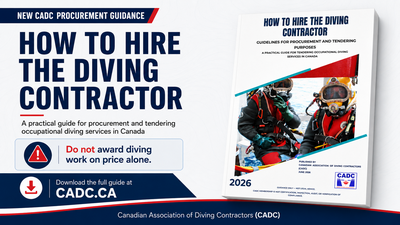
It is occupational work carried out underwater, often in poor visibility, cold water, current, confined access, or around infrastructure that was never designed with a diver in mind. When the work is scoped badly, the problem does not start in the water. It often starts much earlier — in the wording of the RFQ.
That is why the Canadian Association of Diving Contractors has released How to Hire the Diving Contractor: Guidelines for Procurement and Tendering Purposes.
The guide is written for the people who hire diving services, write tender documents, review bids, insure the work, or manage the project. It explains what should be asked before the job is awarded and what should be checked before anyone enters the water.
A low bid is not a bargain if the contractor cannot prove competency, proper supervision, suitable insurance, safe work planning, and emergency readiness. The guide gives procurement staff practical wording, checklists, red flags, and review tools to help separate a proper commercial diving operation from a risky one.
It also addresses a common misunderstanding: recreational scuba training is not a substitute for occupational diving competency. Commercial diving carries different responsibilities, different hazards, and different legal expectations.
This is not a complicated message. If you are hiring diving services, the tender should require more than a price. It should require proof that the work will be done safely, competently, and in compliance with applicable requirements.
The guide is available now at CADC.CA. DOWNLOAD HERE
Download it, read it, and share it with anyone involved in hiring or specifying commercial diving work.
Good tender wording protects the project. More importantly, it protects the people in the water.
 New edition strengthens clarity around occupational diving scope, SCUBA limitations, underwater construction sites, and minimum crew requirements
Mississauga, Ontario — May 15, 2026— The Canadian Association of Diving Contractors is drawing attention to several important changes in the upcoming CSA Z275.2-26 Occupational Safety Code for Diving Operations, the national standard that provides safety requirements for occupational diving operations in Canada.
The 2026 edition includes significant clarifications affecting how occupational diving operations are planned, classified, supervised, crewed, and carried out. The changes address the scope of the Standard, controlled environments, underwater construction sites, restrictions on the use of SCUBA, minimum SCUBA crew levels, and surface-supplied diving crew requirements.
“These changes are important because they help clarify the safety floor for occupational diving in Canada,” said Doug Elsey, P.Eng., Executive Director of the Canadian Association of Diving Contractors. “They reinforce that occupational diving requires proper planning, competent crews, appropriate equipment, effective supervision, and a clear emergency response capability.”
One of the most important changes in CSA Z275.2-26 is the clarification of the Standard’s scope.
The revised scope states that the Standard applies to all occupational diving operations conducted in connection with all types of work and employment, regardless of the industry sector in which the diving activity occurs.
CADC says this is a significant clarification for the general industry because occupational diving hazards are determined by the task, the site conditions, the diving method, the equipment, the emergency response plan, and the competence of the dive crew — not simply by the sector in which the work is being performed.
Whether the diving operation involves construction, salvage, aquaculture, film production, archaeology, inspection, scientific work, public safety, infrastructure, marine maintenance, or another occupational activity, the work must be assessed and managed as occupational diving.
“The sector label does not change the hazard,” Elsey said. “A diver underwater still requires proper supervision, standby capability, emergency planning, competent personnel, and equipment appropriate to the task.”
CSA Z275.2-26 introduces a definition of controlled environment, referring to a diving location where the risk to the diver is assessed as low and supported by a documented risk management assessment. Examples may include protected waterways, pools or tanks with unhindered access to the surface, tended or tethered SCUBA, and locations where there is minimal risk of a diver becoming trapped or lost.
However, CADC notes that the accompanying language is just as important: designating a dive location as a controlled environment does not alter or reduce the operational safety requirements specified elsewhere in the Standard.
This means that “controlled environment” should not be interpreted as permission to reduce safety without proper justification. The designation must be supported by documented risk assessment and actual site conditions. It does not remove the need for competent supervision, proper crew planning, standby diver readiness, emergency response capability, or compliance with other applicable requirements.
The 2026 edition also adds a detailed definition of underwater construction site.
The definition includes underwater locations where construction, destruction, demolition, maintenance, repair, renovation, excavation, blasting, concreting, salvage, installation, disassembly of infrastructure, machinery or equipment, or similar activities are actively taking place. The definition also extends through the water column and onshore to include dive control.
CADC says this clarification is particularly important for clients, contractors, constructors, engineers, municipalities, utilities, insurers, regulators, and procurement authorities involved in underwater work.
The definition is relevant to active work areas involving infrastructure, pipelines, tunnels, intakes, ducts, bridges, roads, wharves, dams, anchorages, underwater film production sets, oil and gas platforms, vessels, and other underwater infrastructure sites.
“This helps remove ambiguity,” said Elsey. “If the work involves active underwater construction, maintenance, repair, demolition, installation, salvage, or similar activity, it must be treated as serious occupational diving work. That affects planning, equipment selection, crew size, supervision, and emergency response.”
CSA Z275.2-26 also strengthens and clarifies where SCUBA shall not be used in occupational diving operations.
The Standard identifies several operations where SCUBA is prohibited, including underwater intakes and/or pipe entry, penetration diving, welding, burning/cutting, high-pressure jetting, most hoisting operations, dredging subject to limited exceptions, most use of power tools, planned diving beyond no-decompression limits, contaminated environments subject to limited exceptions, certain explosive-related work, and diving on an underwater construction site.
CADC emphasizes that SCUBA remains an accepted occupational diving technique where it is appropriate and permitted. However, the 2026 wording makes the limits clearer.
SCUBA has limitations in breathing gas supply, surface control, communications, diver recovery, and emergency response capability. For higher-risk occupational tasks, surface-supplied diving is often the more appropriate method.
“For clients and procurement authorities, this is an important point,” Elsey said. “A lower-priced bid based on SCUBA may not be an acceptable bid if SCUBA is not appropriate or permitted for the work being performed. The diving method has to match the hazard.”
The 2026 edition clarifies that the default minimum SCUBA crew is four persons:
A reduced three-person SCUBA crew may only be considered under restricted conditions. These include diving in a controlled environment, a maximum depth not exceeding 18 m / 60 ft, no contaminated environment, a demonstrated and documented site-specific extraction of an unconscious diver, and a completed site-specific documented risk assessment process, including an emergency action plan.
CADC says this is an important clarification for both contractors and clients.
In practical terms, four is the default and three is the exception. A reduced crew must be justified by the actual conditions of the dive site and supported by proper documentation.
“This is about emergency response capability,” said Elsey. “The question is not simply how many people are needed to get the job done. The question is how many competent people are needed to get the diver out of trouble when something goes wrong.”
For surface-supplied diving, CSA Z275.2-26 confirms that each operation requires a minimum four-person dive crew:
The Standard also confirms important standby diver requirements. The standby diver must use surface-supplied diving equipment, must be capable of responding to the depth of the working diver or divers, and must have adequate breathing gas arrangements to support emergency response.
CADC says the standby diver requirement remains one of the most important life-safety elements in occupational diving.
“The standby diver is not a name on a form,” Elsey said. “The standby diver is part of the emergency response system. In a diving emergency, that capability may be the difference between rescue and recovery.”
CADC says the changes in CSA Z275.2-26 should be reviewed carefully by all parties involved in occupational diving.
For diving contractors, the changes reinforce the need for clear procedures, site-specific risk assessments, proper crew planning, documented emergency response capability, and appropriate selection of diving methods.
For clients, owners, municipalities, engineers, constructors, and procurement authorities, the changes highlight the importance of evaluating diving bids based on safety, competency, equipment, supervision, and compliance — not simply price.
For regulators and safety professionals, the updated language provides clearer reference points for assessing occupational diving operations and identifying when SCUBA use, reduced crews, or inadequate planning may create unacceptable risk.
For insurers and risk managers, the changes provide a clearer basis for asking whether a diving operation has been properly classified, properly crewed, and properly planned.
CADC says the upcoming changes also reinforce the need for national harmonization of occupational diving safety requirements across Canada.
The CSA Z275 Dive Standards are nationally developed and maintained through a consensus-based standards process involving subject-matter experts. CADC supports recognition and adoption of the CSA Z275 Dive Standards as the minimum occupational diving safety framework across all provinces and territories.
“Canada should not have occupational diving safety interpreted differently from one jurisdiction to another,” Elsey said. “The CSA Z275 Dive Standards provide the national safety floor. The 2026 changes show why it is important for regulations and industry practice to stay aligned with the current national standard.”
CADC will continue to advocate for consistent recognition of the CSA Z275 Dive Standards as the foundation for occupational diving safety in Canada.
The Canadian Association of Diving Contractors represents Canada’s occupational diving contractors and promotes the safe conduct of commercial diving operations through recognized standards, competent personnel, effective regulation, and professional industry practice.
CADC members are expected to comply with applicable occupational health and safety legislation and the CSA Z275 Dive Standards as the minimum safety baseline for occupational diving operations.
Doug Elsey, P.Eng.
Executive Director
Canadian Association of Diving Contractors
Email: Delsey@CADC.CA
Phone: 905-542-7410
This release is provided for general information only and does not constitute legal, regulatory, engineering, or occupational health and safety advice. Readers should consult the final published standard, applicable legislation, regulations, and the authority having jurisdiction. CADC does not certify, inspect, audit, or verify compliance by any person, company, contractor, employer, or diving operation.
Dr. George Harpur, a pioneering figure in Canadian diving and hyperbaric medicine, has been honoured with the 2026 Lifetime Achievement Award at the Canadian Underwater Conference & Exhibition. The award recognizes his five decades of leadership, innovation, and service to the diving community.

Dr. Harpur moved to Tobermory in 1974 and was instrumental in establishing the Tobermory Hyperbaric Facility (THF) in 1976. Under his direction, the THF evolved from a local dive‑accident treatment centre into a nationally respected hub for research, training, equipment testing, and hyperbaric oxygen therapy.

Throughout his career, Dr. Harpur and the THF team supported a wide range of underwater operations, including:
Geological Survey of Canada Arctic diving teams
Parks Canada’s Underwater Archaeology Team during the Franklin expedition search
Commercial diving operations on Lake Erie
Ontario Provincial Police Underwater Search and Recovery Unit
Dr. Harpur has also contributed extensively to diver education and safety, delivering lectures, publishing research, and sharing insights from investigations into diving incidents worldwide. In accepting the award, he emphasized that the recognition reflects the collective work of the entire THF team.
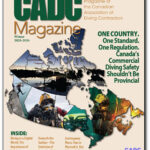
The Winter 2025–2026 edition of CADC Magazine is not a light read — and it wasn’t meant to be.
This issue goes straight to the core of where Canadian commercial diving stands today, where it’s drifting, and what needs to change if we’re serious about safety, professionalism, and consistency across the country.
The cover theme says it plainly: One Country. One Standard. One Regulation. Canada’s commercial diving safety framework cannot keep fragmenting by province, sector, or political convenience. The water doesn’t care where you’re working — and neither should the minimum level of protection afforded to the people doing the work.
Inside this issue, you’ll find:
In Beneath the Surface: The Evolution of Canadian Diving, CADC Executive Director Doug Elsey reflects on more than five decades in the industry — from the early, unstructured days of commercial diving to the standards-driven profession we rely on today. It’s not nostalgia. It’s context. And it’s a reminder that today’s rules exist because someone learned the hard way.
As logs, certifications, and medicals go digital, verification has never been more important. In Diving in a Digital World: The Importance of Validation, DCBC CEO Tracy Childs explains why convenience without validation creates risk — and how credential verification protects contractors, supervisors, inspectors, and divers alike.
The feature article One Country. One Standard. One Regulation tackles the growing problem of provincial carve-outs and sector-specific exemptions head-on. It explains why patchwork regulation weakens safety, increases liability, and puts divers at risk — and why CSA Z275 standards must form the national baseline, everywhere in Canada.
Aaron Griffin’s Contingency Plans: You’ve Planned It, But Did You Drill It? delivers one of the most practical pieces in the issue. Drawing from real drills and real failures, it shows how seemingly solid emergency plans fall apart under stress — and why drills are not paperwork, but lifelines.
In In Depth: Major Revisions in the 2026 Edition of CSA Z275.2, Jonathan Chapple walks through the most significant updates to the standard, including:
Mandatory risk management
Clearer SCUBA limitations
Reinforced minimum crew requirements
Human factors in diving
These aren’t theoretical changes — they reflect how work is actually being done in the water today.
The issue also highlights Canpac Marine Services in the Member Spotlight and showcases CADC members working in some of the toughest environments in the country. It’s a reminder that professionalism isn’t marketing — it’s how the job gets done when no one’s watching.
This edition of CADC Magazine isn’t about headlines or fluff. It’s about holding the line on safety, competence, and consistency in an industry where the margins are thin and the consequences are real.
If you work in Canadian commercial diving — as a contractor, supervisor, diver, regulator, insurer, or client — this issue is worth your time.
👉 Read or download the Winter 2025–2026 CADC Magazine now
Because standards don’t matter until someone needs them — and by then, it’s too late to wish we’d paid attention earlier.
 The Canadian Association of Diving Contractors (CADC) is leading a renewed national initiative to harmonize occupational diving safety standards across all provinces, territories, and the federal government. This effort—known as the Harmonization Project—aims to bring Canada’s diving industry under one consistent, modern, and enforceable safety framework based on the CSA Z275 Diving Standards.
Commercial diving plays a vital role in the Canadian economy, supporting marine construction, infrastructure maintenance, aquaculture, environmental work, scientific research, and emergency response. Despite the national scope of these operations, the rules governing diver safety vary widely. Canada currently has 13 different regulatory systems, creating inconsistencies in requirements, training recognition, enforcement expectations, and labour mobility.
CADC is working with regulators and stakeholders to complete the work started in the 1990s and move Canada toward a unified national standard.
Commercial diving remains one of the highest-risk occupations in the country. The CSA Z275 series provides clear, detailed, and technically validated requirements for safe diving operations. A harmonized national system ensures these protections apply equally everywhere.
The CSA Z275.4 competency standard ensures divers, supervisors, tenders, and hyperbaric physicians meet a consistent level of training and experience. Harmonization removes barriers to interprovincial mobility and strengthens the professionalism of the workforce.
A unified approach eliminates duplicated provincial efforts and removes outdated or conflicting requirements. By adopting the latest CSA standards, jurisdictions gain access to a modern national framework updated regularly by experts from industry, labour, government, and technical fields.
Under Canada’s Criminal Code, employers must take reasonable steps to protect workers. CSA standards provide a clear definition of these obligations and support consistent enforcement and due-diligence expectations across jurisdictions.
Transitioning to a national standard does not require rewriting every provincial regulation. Jurisdictions can adopt the CSA standards through:
Direct incorporation by reference in OHS regulations
Adoption through enforceable codes of practice
Updating older CSA references to the latest editions
These approaches maintain provincial authority while establishing a unified national safety baseline.
The foundation for harmonization was established during the 1997 National Harmonization Project. That work identified the CSA Z275 standards as the clear, consensus-based solution for a unified Canadian diving safety regime.
Today, CADC is advancing this initiative with renewed urgency. The industry, regulators, and technical experts are aligned in recognizing the benefits of a modern, harmonized approach.
Bringing all jurisdictions under one set of national standards will:
improve safety,
enhance mobility,
reduce administrative duplication,
strengthen accountability, and
support a more competitive, professional industry.
CADC will continue working with government partners and industry stakeholders to advance this important national initiative.
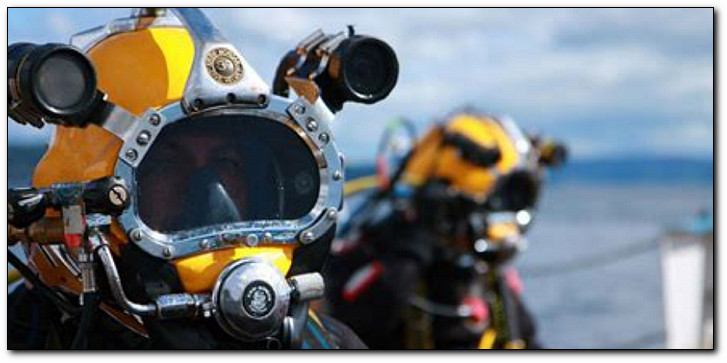
August 11, 2025 – [TORONTO, ON] — The Canadian Association of Diving Contractors (CADC) is raising urgent safety concerns over the Ontario Government’s recent amendment to O. Reg. 629/94 – Diving Operations under the Occupational Health and Safety Act.
Effective July 1, 2025, Ontario Regulation 140/25 amended O. Reg. 629/94 to create a sector-specific exemption for the screen industry. The change removes the requirement for certain underwater roles to hold certification to the CSA Z275.4-22 – Competency Standard for Diving Operations, unless the diver is explicitly assigned to a safety-critical role such as a standby diver or supervisor.
According to CADC, this change:
Originated from requests and advocacy by representatives of the film industry.
Was implemented without formal consultation with the broader commercial diving sector.
Allowed only one week of public posting before the amendment took effect.
Mirrors a 2014 regulatory exemption granted to the aquarium sector — also introduced without sector-wide safety consultation — which remains in place today.
“This is not modernization — it is the removal of a long-standing safety requirement that applied equally across all sectors,” said Doug Elsey, P.Eng., Executive Director of CADC. “Water doesn’t care if you’re filming a movie or repairing a bridge — the hazards are the same. By removing the requirement for CSA-certified competency in certain roles, Ontario is creating a two-tier safety system and shifting the legal burden from regulation to individual supervisors.”
Until now, Ontario’s diving regulation applied equally to construction, inspection, salvage, research, and screen industry diving. All divers had to meet the same baseline for competency, medical fitness, equipment, and emergency protocols — regardless of employer or project type.
By carving out exemptions based on sector identity rather than operational risk, the Ministry has replaced a consistent safety framework with selective exceptions. CADC warns this approach sets a precedent for other sectors to seek similar carve-outs without a technical or risk-based justification.
The CSA Z275.4-22 standard is Canada’s nationally recognized minimum competency benchmark for occupational divers. It ensures divers have the documented training, skills, and capability to safely operate in high-risk underwater environments.
Allowing uncertified divers to work in non-safety-critical roles in the screen industry increases the likelihood of:
Use of unqualified personnel lacking critical knowledge of decompression, emergency procedures, contamination hazards, and equipment operation.
Higher accident risk, where inadequate response in an emergency can endanger both the diver and others in the operation.
Erosion of professionalism, reducing the value placed on proper training and certification.
Under the amended regulation, supervisors may be required to oversee uncertified or underqualified divers. This substantially increases both legal and ethical liability, as they must now assess and mitigate the risks posed by divers whose competencies are not verified to CSA standards.
In the event of an incident, supervisors could face prosecution under Bill C-45 (the Westray Law) if it is determined they failed to take all reasonable steps to protect the safety of workers.
“A supervisor’s role assumes the divers under their control are already competent,” Elsey said. “When that assumption is removed, supervisors become the last barrier to systemic failure — without the tools or authority to guarantee competence.”
Previously, enforcement officers could confirm compliance by checking for valid CSA Z275.4 certification. The new exemption forces inspectors into case-by-case determinations, such as:
Is the diver’s role “supporting the safety” of another?
Is the dive “for screen purposes” or incidental maintenance during production?
Does the diver qualify under the exemption?
This ambiguity creates inconsistent enforcement and the potential for work to be misclassified to avoid competency requirements.
The CSA Z275 series of diving standards are the product of decades of work by regulators, industry, safety experts, and medical professionals. They establish the minimum — not the maximum — safety baseline for diving in Canada.
By allowing certain sectors to bypass these standards, Ontario risks:
Undercutting CSA’s role as a unifying national safety benchmark.
Encouraging other provinces to weaken their alignment with CSA standards.
Sending the message that safety compliance can be negotiated rather than determined by operational hazards.
CADC urges the Ontario Government to:
Rescind the sector-based exemption in section 4.1(8) of O. Reg. 629/94.
Reaffirm a task-based, risk-driven approach that applies equally to all sectors.
Ensure enforcement clarity by requiring all divers to meet CSA Z275.4 competency.
Engage in open consultation with the diving industry before making regulatory changes affecting safety.
“Ontario has been a leader in aligning diving regulations with national standards,” Elsey added. “This amendment reverses that leadership and opens the door to lobby-driven exceptions. We can modernize the regulation — but not at the cost of diver safety.”
Disclaimer:
This statement reflects the position of the Canadian Association of Diving Contractors based on its interpretation of Ontario Regulation 140/25, Ontario Regulation 629/94, and the CSA Z275.4-22 – Competency Standard for Diving Operations. The information provided is accurate to the best of CADC’s knowledge as of the date of publication and is based on the text of the regulation, publicly available information, and CADC’s expertise in commercial diving safety. CADC will update its position if further clarification or amendments to the regulation are issued by the Ministry of Labour.
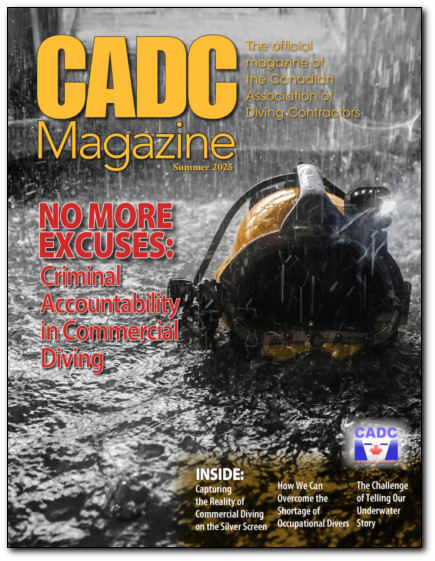 If there’s one throughline in this issue of CADC Magazine, it’s this: excuses in our industry are not tolerated.
Not for skipping briefings.
Not for running inadequate crews.
Not for cutting corners because “it’s always been done this way.”
This one is reflected in every article you’ll read here. From criminal court rulings to offshore emergencies, from diver shortages to legacy preservation—this issue is a wake-up call.
We lead with the hard truth. In “No More Excuses,” we break down the King v. R. case, where a site supervisor’s negligence resulted in a young worker’s death—and a three-year prison sentence. The ruling was done this spring in New Brunswick. This wasn’t an offshore dive gone wrong. It was a land-based tragedy in another industry. But make no mistake— a reality of the consequences of not following Canada’s Bill C-45 (about the requirement to protect your workers) is set for all of us:. If you’re in a position of responsibility and fail to follow safety standards, the consequences can be criminal. That warning applies directly to our sector. Dive supervisors, project managers, clients—this is your red flag. This is reality. Not only can you face fines – you can face criminal charges – and jail!!
We follow it with “Last Breath”, where veteran DSS Dennis Barrington peels back the dramatics of a major saturation diving film to reveal a sobering reality: emergencies offshore don’t wait for permission. When the lights go out and a diver’s lifeline is severed, it’s the people on site—their training, experience, and split-second decisions—that save lives. Dennis connects this to his own history on the Grand Banks, where near-misses and rescues were part of the job, and where the margin for error was—and still is—razor thin.
We shift gears with “DCBC Update”, where Tracy Childs brings us the numbers we can’t ignore almost half of our newly certified divers leave the industry within two years. Training isn’t the issue—retention is. We need to rethink how we support divers through their early careers, how we make the work sustainable, and how we help qualified people return to the industry when they’re ready.
In “The Challenge of Telling Our Underwater Story”, Vickie Jensen captures the heart of British Columbia’s subsea legacy. From HYCO’s Pisces submersibles to Phil Nuytten’s Deep Rover, this province punched well above its weight in global undersea innovation. We need to invest in preserving that story before it slips below the surface. It’s more than history—it’s our origin story.
Then we take you to the frontlines in “Member Spotlight: ODS Marine”. This Ottawa-based company exemplifies what it means to operate safely, smartly, and with pride. Their barge systems, dive crews, and project scope show the kind of technical capability Canadian contractors bring to the table—and the culture of mentorship that keeps divers in the industry for the long haul.
Jonathan Chapple gives us a critical look ahead in “In Depth: CSA Z275.2 Update”. The next edition of Canada’s diving safety code is in the works, and it’s not just a refresh. With new sections on risk assessment, diving in currents, human factors, and the long-overdue formal definition of an underwater construction site, the standard is evolving to meet modern challenges. These aren’t theoretical changes—they’re the backbone of how we operate safely and legally.
And finally, we take a moment to honour one of our own. “Glen Costello Honoured” pays tribute to a man who led with integrity, fought for safer diving practices, and left a legacy that shaped both the CADC and Canada’s commercial diving standards. His Lifetime Achievement Award is richly deserved—and a reminder that leadership isn’t always loud. Sometimes it’s just steady, persistent, and unshakable.
So where does that leave us?
Right here, in a moment of reckoning—and opportunity.
To raise the bar. To train better. To supervise better. To demand more from ourselves and the people who hire us. To do our job safely. To make it safer.
To say what needs to be said when a job isn’t safe.
And to mean it.
Because the next time a diver’s life is in your hands, there won’t be time to Google a dive standard or regulation.
You’ll either know what to do—or you won’t.
You’ll either have followed dive procedures as outline in CSA Z275.2— Diving Operations – or you didn’t.
You’ll either have planned for the worst—or hoped for the best.
The difference isn’t just professional. It’s personal. It’s legal. It can mean the difference between life or death.
As an association, CADC will keep promoting professionalism and safety. But this isn’t about policy. It’s about education. It’s about people.
People like Glen. People like your divers. People like you.
Stay professional. Stay informed. Stay safe. No more excuses.
Have a successful SAFE summer – everyone comes home at the end of the dive!
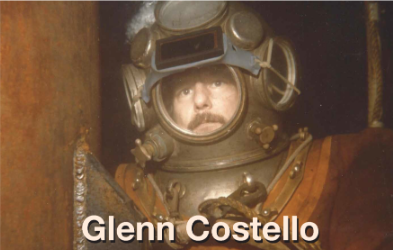 At the 2025 Canadian Underwater Conference & Exhibition in Vancouver, BC, the Diver Certification Board of Canada (DCBC) presented its Lifetime Achievement Award posthumously to Glen Costello—a respected commercial diving pioneer, founder of Canpac Divers Inc., and past president of the Canadian Association of Diving Contractors (2012–2014).
The award was accepted by his wife, Charlie Costello, during a moving ceremony that recognized a lifetime of groundbreaking achievements, unshakable ethics, and advocacy for diver safety.
Glen’s underwater career was built on a foundation of hard-earned experience—from military service in the Peace Keeping Corps in Egypt and the Middle East, to ironwork on major infrastructure projects, and finally into commercial diving where he left an indelible mark. As President of Canpac Divers from the early 1980s until 2012, Glen led deepwater projects involving ROVs, manned submersibles, salvage, and marine construction across Canada and abroad.
He was instrumental in organizing commercial divers under Local 2404 of the Pile Drivers, Divers, Bridge, Dock and Wharf Builders union, fighting for fair wages, pensions, and safe working conditions. He also contributed significantly to regulatory development, serving on CSA dive standards subcommittees and assisting in the formation of diving safety regulations for WorkSafeBC.
Glen’s technical experience was wide-ranging—hydrographic survey, NDT, submarine cable installation, ROV work, salvage—and his willingness to share knowledge made him a mentor to many. His integrity, persistence, and unwavering commitment to diver safety made him a fitting recipient of this national honour.
The CADC congratulates Charlie Costello and the Costello family on this well-earned recognition of Glen’s enduring legacy. His contributions continue to shape our industry and the standards we uphold today.

(This is a public service announcement from the CADC to all diving contractors – April 20 2025)
A recent legal decision out of New Brunswick Feb 2025 has major implications for all of us in the commercial diving sector as well as any industrial or commercial construction industry. Don’t ignore the warning.
In King v. R., 2025 NBCA 12e, the New Brunswick Court of Appeal upheld a criminal negligence conviction against a worksite supervisor after the death of an 18-year-old worker. The supervisor, who failed to follow basic confined space safety protocols, was sentenced to three years in prison. His actions—or more accurately, his inaction—cost a young worker his life.
This decision wasn’t about fines. It wasn’t about policy violations. It was about criminal accountability under Bill C-45—Canada’s Westray Law. And for anyone directing high-risk work like commercial diving, the message could not be clearer: if you neglect safety and someone dies, you may go to jail.
In the King case, a leak test was conducted in an 8-foot confined space while a young worker remained inside. No hazard assessment was done. No emergency plan was in place. No confined space procedures were followed. The supervisor didn’t read the equipment’s safety manual. He never warned the worker the space was going to be flooded. The result was fatal.
The court ruled this was a marked and substantial departure from what a reasonable supervisor would have done. They confirmed that a “common sense” hazard like flooding a confined space during a leak test was enough to establish criminal negligence.
Let’s be clear—this could have easily occurred in a commercial diving context: confined space entries, pipeline work, tanks, lockout-tagout failures, inadequate supervision, or improperly briefed divers. The parallels are unmistakable.
This case sends a message to supervisors and employers across Canada—the courts are prepared to impose jail sentences when safety is ignored. In the diving industry, where hazards are immediate and often life-threatening, we must assume the legal threshold is even higher.
In the case of CADC members, we are expected to meet—and in many cases exceed—the safety standards laid out in CSA Z275.2 and Z275.4. These are not just best practices—they are often incorporated directly into law. Courts will judge our actions against these standards if things go wrong.
For CADC Contractors – and Dive Contactors in general – and Supervisors:
For Clients Who Hire CADC Members and ANY diving Contractor:
King v. R. wasn’t about policy. It was about accountability. The case proved that criminal negligence laws under Bill C-45 apply to supervisors and companies who ignore known risks.
In our industry, we are often dealing with confined space entries, delta P, unstable environments, heavy lifting, and pressure systems. If a diver is hurt or killed because a hazard was ignored, the legal consequences can be catastrophic—for the supervisor, the employer, and potentially the client.
Don’t assume this can’t happen to you or your team. Now is the time to act:
 One glance outside at the weather in December is all it takes to remind us that winter is here, along with its ice and snow, and all the unpredictable changes to climate that makes life more challenging. But, as we in the industry know, commercial diving was never meant to be easy.
This is a profession that demands precision, calculated risks, and the ability to solve problems in the most challenging environments. Every dive balances expertise, experience, and safety protocols, with lives depending on getting it right.
In this issue of CADC Magazine, we shine a light on the work, innovation, and regulations that keeps our industry moving forward and set new standards for safety, professionalism, and ingenuity.
A CADC Magazine deep dive In the cover story, ‘Behind the Scenes: What It Takes to Approve a New Diving Standard,’ I guide you through the often tedious but critical process of developing new safety standards. From identifying gaps to navigating red tape to gathering input through public reviews, the article highlights the dedication required to ensure divers return home safely. It’s a long, detailed journey, but one that’s essential to saving lives and upholding the professionalism of our industry.
Kirk Krack’s feature, ‘Rolling in the DEEP: The ‘NASA of the Sea’ Takes Saturation Diving into the 21st Century,’ explores how DEEP is revolutionizing saturation diving with their groundbreaking subsea habitats, Sentinel and Vanguard. Inspired by Canadian diving pioneers such as Dr. Joe MacInnis, DEEP is redefining what’s possible in underwater exploration. Imagine living and working comfortably on the seabed – it’s habitat living version 2.0!
Written by Bob Clarke of ASI, ‘The Isolation of Failed Piping Using Remotely Operated Vehicles’ demonstrates the ingenuity of ROV technology in tackling complex underwater challenges. Detailing projects at British Columbia’s This is a profession that demands precision, calculated risks, and the ability to solve problems in the most challenging environments. Every dive balances expertise, experience, and safety protocols, with lives depending on getting it right.
Winter 2024-2025 up front requirements, the article underscores CSA’s commitment to evolving safety and operational needs. Safer, smarter, better At its core, this issue of CADC Magazine reflects the intentional effort and collaboration required to make the commercial diving industry safer and smarter. Excellence does not happen by chance – it is built on dedication and an unyielding drive to improve.
Whether it’s advancing safety standards, embracing new technologies, or showcasing stories of resilience and innovation, this edition is filled with practical insights you can apply in your work.
So, grab a coffee, watch the snow fly, and dive into the pages ahead. These stories are more than words – they’re a call to action for all of us to keep pushing boundaries, solving problems, and leading the way in commercial diving.
Remember, it’s cold out there, but the water below the ice is always a steady 0°C (32°F). Being a tender in Canada’s winter might suck – but we wouldn’t trade this work for anything. Welcome to our world. Stay safe, and all the best in the New Year!
 UnderwaterINDUSTRY News

 Dr. George Harpur, a pioneering figure in Canadian diving and hyperbaric medicine, has been honoured with the 2026 Lifetime Achievement Award at the Canadian Underwater Conference & Exhibition. The award recognizes his five decades of leadership, innovation, and service to the diving community.
Dr. Harpur moved to Tobermory in 1974 and was instrumental in establishing the Tobermory Hyperbaric Facility (THF) in 1976. Under his direction, the THF evolved from a local dive‑accident treatment centre into a nationally respected hub for research, training, equipment testing, and hyperbaric oxygen therapy.
Throughout his career, Dr. Harpur and the THF team supported a wide range of underwater operations, including:
Dr. George Harpur, a pioneering figure in Canadian diving and hyperbaric medicine, has been honoured with the 2026 Lifetime Achievement Award at the Canadian Underwater Conference & Exhibition. The award recognizes his five decades of leadership, innovation, and service to the diving community.
Dr. Harpur moved to Tobermory in 1974 and was instrumental in establishing the Tobermory Hyperbaric Facility (THF) in 1976. Under his direction, the THF evolved from a local dive‑accident treatment centre into a nationally respected hub for research, training, equipment testing, and hyperbaric oxygen therapy.
Throughout his career, Dr. Harpur and the THF team supported a wide range of underwater operations, including: